
Welcome to the iPrepBuddy Monthly Newsletter!
Stay informed with the latest updates on our platform and the newest advancements in ophthalmology. This newsletter aims to keep you prepared for your upcoming exams.
by Dr Chloe Walugembe on 01/10/2026
Clinical Insight: Posner-Schlossman Syndrome
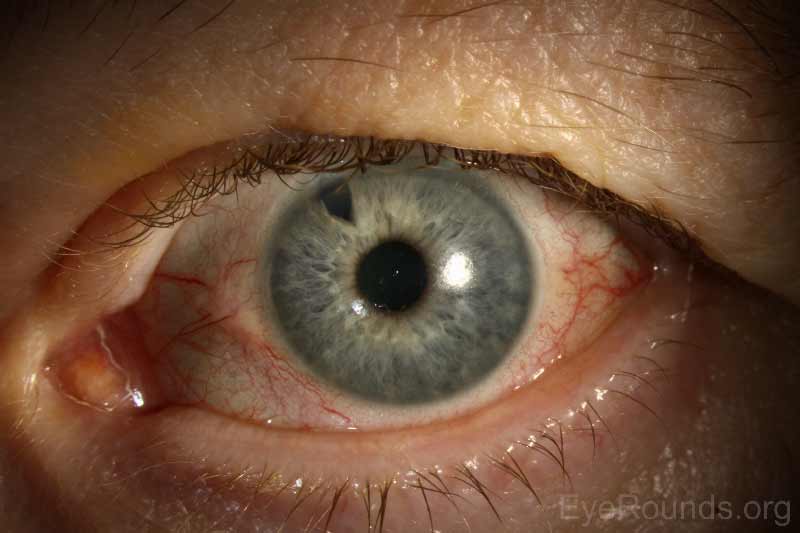
Figure 1: Image of the left eye with mild conjunctival injection and posterior synechiae at 11 o'clock. The cornea is clear and a surgical PI is visible at 11 o'clock (eyerounds.org).
Posner-Schlossman syndrome (glaucomatocyclitic crisis) is a rare, unilateral inflammatory glaucoma, typically affecting adults aged 20–60, characterised by recurrent attacks of mild nongranulomatous anterior uveitis with markedly raised IOP and open angles [1]. Despite pressures often exceeding 40 mmHg, patients usually report only mild discomfort or blurring, and examination shows a quiet eye with a few fine keratic precipitates, with IOP returning to normal between attacks [1].CMV is the leading suspected cause, and treatment consists of topical steroids with aqueous suppressants Gonioscopy is key to distinguishing it from acute angle closure, in which the angle is closed and the presentation more painful [1]. Although once considered benign, repeated attacks can lead to glaucomatous optic neuropathy, so long-term follow-up is needed [2].
Updates in Ophthalmology
1. Dense deposit disease: when drusen point to the kidneys
Dense deposit disease (DDD), a C3 glomerulopathy driven by dysregulation of the alternative complement pathway (often via CFH mutations), deposits electron-dense material in both the glomerular basement membrane and Bruch’s membrane, two structures with strikingly similar architecture. The result is bilateral drusen-like deposits, often in patients far younger than those typically seen with AMD; in one case series, all patients with DDD had drusen and impaired night vision. Although central acuity is often preserved, retinal pigment epithelial changes, macular atrophy and choroidal neovascularisation can develop and threaten vision. The take-home: in anyone under 50 with drusen, think kidneys. Screen with urinalysis and renal function, refer early if abnormal [3].
2. The Flying Cannula: A Significant Patient Safety Risk
The “flying cannula” was an important patient safety issue highlighted at the Moorfields Cornea Symposium, drawing attention to the risk of cannulas detaching from syringes during intraocular surgery. A 2025 survey of 550+ anterior-segment surgeons, published in the Journal of Cataract & Refractive Surgery, found that 84% had experienced cannula detachment, 78% had witnessed harm resulting from the complication, and 50% reported ocular damage during the most recent incident. Furthermore, 87% felt that improved cannula design or a dedicated safety device was needed. Potential consequences include iris damage, posterior capsule rupture and retinal injury. These findings highlight the importance of secure syringe–cannula connections, consistent theatre safety checks and improved equipment design to reduce avoidable harm and protect patients’ vision [4].
3. Can trainees safely perform immediate sequential bilateral cataract surgery?
A Moorfields study published in Eye (2025) compared outcomes of immediate sequential bilateral cataract surgery (ISBCS) performed by trainees and consultants in 620 patients (1,240 eyes). Trainees performed 45% of operations and, despite operating on eyes with a higher predicted risk of posterior capsule rupture, achieved comparable outcomes. Median postoperative visual acuity was 0.1 logMAR in both groups, with no statistically significant difference in complication rates or refractive outcomes [5].
Take-home message: With appropriate patient selection and consultant supervision, ISBCS may offer valuable training opportunities while maintaining encouraging clinical outcomes—potentially benefiting both surgical education and NHS cataract services.
4. RETFound: Making retinal AI accessible to researchers worldwide
Developed by researchers at Moorfields Eye Hospital and UCL, RETFound is a foundation AI model trained on approximately 1.6 million retinal images. It has the potential to support a range of ophthalmic research applications, including disease detection and prediction of future health outcomes. Importantly, RETFound is not simply a research concept: its code and pretrained model weights are publicly available, allowing researchers worldwide to explore and adapt the technology for their own studies. Although it is not currently an approved standalone diagnostic tool, it represents an exciting step towards more accessible and adaptable AI in ophthalmology. Explore RETFound: GitHub – RETFound
iPrepBuddy Updates:
Be sure to checkout this ophthlamology tracker to see how many points you have (eyescore.io)
iPrepBuddy are offering 1:1 calls with any ST1 applicants who are applying this cycle. All they have to do is sign up an email for the demo on the website, and email "sean@iprepbuddy.com" asking for a 1:1 call.
Good luck to those sitting the Part 2 FRCOphth Oral this November!
Upcoming Conferences
International/ National
British and Eire Association of Vitreoretinal Surgeons (BEAVRS) Annual meeting | 5th-6th November | Oxford
UK and Éire Glaucoma Society Annual meeting (UKEGS) | 10th-11th November | Manchester
United Kingdom &Ireland Society of Cataract & Refractive Surgeons (UKISCRS) | 19th-20th November 2026 | London
Contact lenses and ocular surface Annual Scientific Meeting 2026 (MCLOSA) | 4th December | London
Moorfields Advanced Vitreoretinal Congress (MAVERICK) | 30th January 2027 | London
Regional
UK Conferences currently accepting abstracts
Moorfields MAVERICK 2027. Deadline: 13 November 2026 (MAVERICK website) Topics: Vitreoretinal surgery, retinal detachment, PVR and surgical videos (SOON APPROACHING)
UK Neuro-Ophthalmology Society (UKNOS) 2027 Deadline: 27 November 2026 UKNOS website
Topics: Optic neuropathy, papilloedema, visual field defects and neurological eye disease.RCOphth Annual Congress 2027 Deadline: 1 December 2026 (RCOphth website)
Topics: General ophthalmology, squint, paediatric ophthalmology, surgical outcomes and clinical audits.Medical Ophthalmological Society UK (MOSUK) 2027 Deadline: 8 January 2027 — verify with organisers. MOSUK website
Topics: Medical retina, systemic disease affecting the eye and clinical case presentations.